Amazing Materials to Print On
Updated: Jun 30
Our flatbed printers can print on virtually any rigid material up to 45mm thick. One of the things that sets our flatbed printing service apart is the sheer range of surfaces we can work with - metals, acrylics, glass, timber, specialist papers and more. The result is that printing becomes a truly collaborative, artistic process rather than a simple reproduction exercise.
Below, we walk through the materials we work with most often, with real examples from artists we’ve collaborated with. If you have an idea that isn’t listed here, do get in touch - we love a challenge.
In this article
Prints on Metal
Printing on metal works best when you want to incorporate the material itself into the artwork - letting raw, unprinted areas show through as part of the composition. We work closely with each artist to ensure the printed image and the substrate enhance one another, rather than one simply sitting on top of the other.
If your goal is a thin, rigid panel where the entire surface is covered by the print, then Dibond or Alupanel are usually the right choice. These composite aluminium panels give a clean, consistent result and are ideal for straightforward high-quality reproduction.


This small print on supplied brass, produced in collaboration with @tikkafromeast, incorporates the material into the background of the image as well as some areas of the printed image itself. These areas are printed without a white base layer behind them, so the bras interacts directly with the colour inks. The original is a painting on canvas that was adapted through our collaborative artwork process to incorporate the brass into the image. Over time, the artist intends the bras to oxidise, creating a genuinely unique and evolving artwork.


For artists whose originals are also painted on aluminium, printing on the same substrate creates a particularly faithful reproduction. The surface sheen and slight reflectivity echo the original in a way that paper simply cannot. In some cases, the silver of the aluminium is subtly incorporated into the image itself, so that the viewer becomes aware of the material beneath as they move around the work.
This image demonstrates how layering techniques can transform a metal print. A silkscreen fluorescent colour was laid down first, then the digital flatbed image placed over it, allowing some of the aluminium to show through, with a flatbed varnish applied on top. The interplay between silkscreen, digital and substrate creates something genuinely impossible to achieve with a single process.


This collaboration with Louise Dear really takes things to another level. The aluminium is used as a base, gold leaf is applied before the digital flatbed image goes on, and then a gloss varnish is laid over the top. The result is a layered, luxury multiple that commands attention in any setting.
Work for artist Louise Dear — aluminium panel with gold leaf applied before the digital print, finished with a high-gloss varnish.
Presentation options: Metal panels can be hung directly using a picture-rail hanging system, or framed in a tray frame without glazing - the surface of the print is the artwork, and covering it with glass would diminish it.
Prints on Glass and Acrylic
Printing on glass or acrylic opens up a world of opportunities that we can work through with you. Both materials reward creative thinking about what goes behind the surface, as well as what is printed on it - layering, depth and translucency are all part of the conversation.
This beautiful print was produced on the reverse of etched glass supplied by the artist - meaning the digital print was only one component of the finished piece. The artist then added gold leaf and hand-painted the glass to create a series of originals. We also produced smaller companion pieces on glass, playing with the use of white ink behind some areas and not others to create zones of translucent colour alongside fully opaque passages.
These mini acrylic prints for Sorcha Bridge Photography were designed as ready-to-hang framed products. Gold paper behind the acrylic provides the background, giving the pieces a richness that belies their compact size. The small format makes a great ready-to-take product for art fairs and shows.


These larger prints take depth further - the bird image sits on the front of the acrylic, while the background is printed on holographic paper placed behind it, creating a layered sense of space. Acrylic is particularly well-suited to playing with depth and to printing on both its front and back faces.


Our most ambitious acrylic project to date was a series of four large works produced in close collaboration with artist Janna Nicole. The brief was to recreate the feel of her intricate collage originals using multiple layers of non-reflective acrylic. The process began right back at pre-press stage: we worked with Janna to build the artwork in discrete layers, which were then photographed in layers. This meant the finished pieces carry all the visual complexity of the originals without the tonal compression you get when photographing a layered collage as a single flat image. The results demonstrate how versatile acrylic can be as a medium for creating a genuinely high-end, limited edition multiple.


We can also print on round or cut-to-shape acrylic or glass. Unusual formats - circles, arches, irregular outlines - are all achievable and often open up new creative possibilities that a rectangular format would foreclose. Acrylic can be displayed attached directly to a wall, framed, or even presented on the floor as a large-scale statement piece.
Prints on Holographic Paper
Our SwissQ printer has opened up the possibility of printing on holographic paper - a material that brings its own shifting, iridescent character to whatever image is placed on it. As with all the specialist substrates we work with, the key creative question is: how do you want the holographic quality to show? You can cover the entire surface, letting the shimmer play through the printed image as a whole, or you can design the artwork so that only certain areas - details, backgrounds, specific elements - catch and scatter the light.
These prints for RHYMEZLIKEDIMEZ were designed entirely around the holographic paper substrate, taking full advantage of the SwissQ printer’s additional capabilities - texture printing and selective varnish - to create a finished piece that is highly tactile as well as visually arresting.


Thinking carefully about how you will use the holographic paper in your image - as a whole surface or selectively - is important to getting the best finished work, and we are always on hand to help guide the process.
Prints on Specialist Papers
Alongside holographic paper, we have produced work on a wide range of specialist papers. Our starting point for exploring coloured stock options is often the GF Smith swatch book, which offers an exceptional range of colours, textures and weights.
The Ebony Colour Plan paper in these Roger Dean prints gives an amazing dark background to his The Very Best of Osibisa’ album cover image. To make sure the colours of the Elephants face really pop a layer of white is applied first before the colours, the back lettering is printed without the white, and the UV inks give the back a stunning glossy finish.
This bright washing line image on yellow GF Smith paper is a conscious creative choice to present the work differently to the original. The yellow ground brings energy and warmth, and the resulting print is something genuinely new rather than a reproduction. It is worth noting that specialist papers come in fixed sheet sizes, so maximum print dimensions are determined by the material - we will always advise on what is achievable before you commit.


Wood Panels
Primed wooden panels are not just for painting on. Our flatbed printers can print directly onto them, with all the same options available as on any other substrate - including texture printing and spot varnishes. Ready to hang as they are, or finished in a tray frame, printed wood panels have a warmth and physicality that other materials simply don’t offer.
The smooth surface of a birch ply panel is particularly well suited to printing. The edges can be left natural to show the wood grain, or painted to complement the printed image. We can cut panels to any size and shape, including circles and other unusual formats, which opens up some genuinely exciting possibilities.

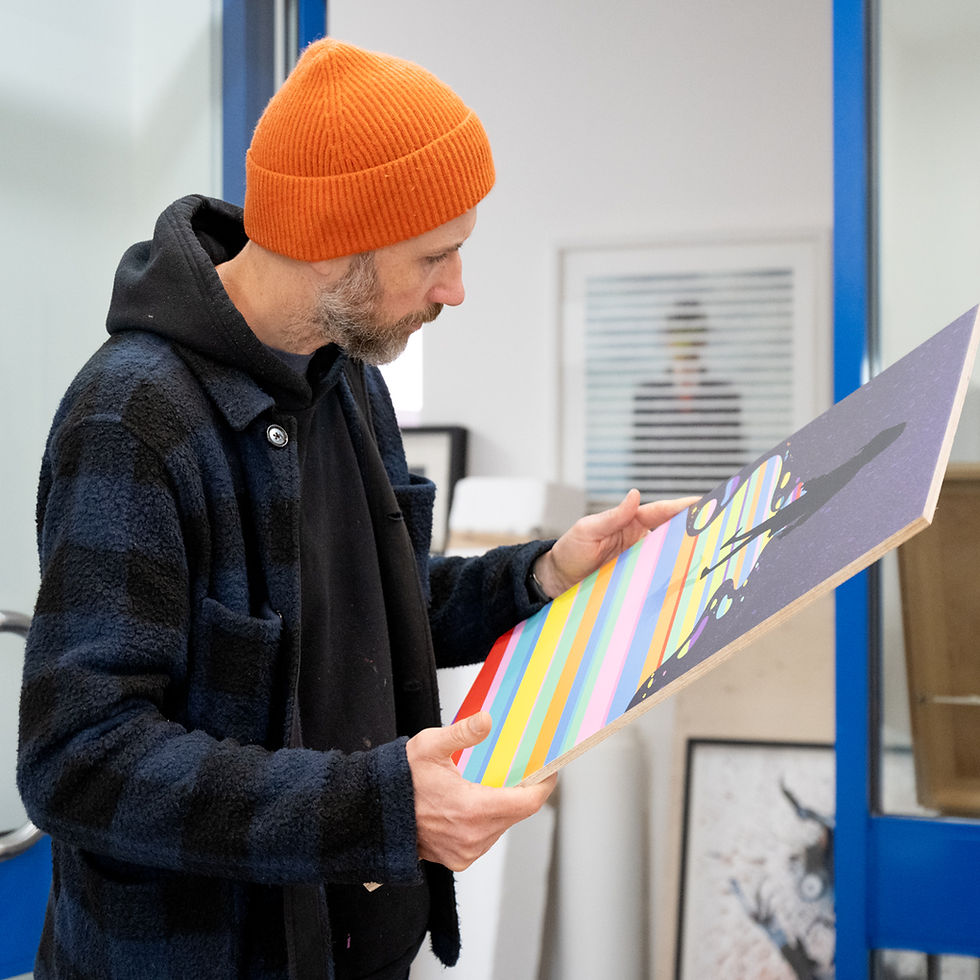
Presentation options include hanging directly - the ply edges become part of the visible object - or setting the panel into a tray frame for a cleaner, more gallery-ready finish. The wood surface means no glazing is required, allowing the texture of the print and any additional varnish layers to be experienced directly.
Things to Think About When Using Unusual Materials
Choosing an unusual substrate is one of the most exciting decisions in producing a print edition - but it pays to think through a few key questions before committing:
• What is the material bringing to the work? How do I want it to show? Is it part of the original concept, or making the work into something new? The answers shape all the decisions that follow - particularly around whether you print with or without a white base layer.
• Have you thought about what goes on behind the surface as well as on top? For glass and acrylic, especially, the backing material is as much a part of the finished work as the print itself.
• What price do I want to sell the finished work at? Is size important, or can this be flexible to reach a price point? Be aware that size may be restricted by the material - specialist papers only come in certain sizes, and panels only go so big. We can help you find the right balance between ambition and budget.
• How will my customer hang or display the work? You might want to think about framing as well as printing, and whether to include hanging hardware or instructions.
• Give us an idea, and we love to come up with a solution. The earlier in the process we are involved, the more we can contribute.
Inspired by what's possible? Let's talk.
Whether you have a fully formed idea or just a feeling about a material or technique, we would love to hear from you. We take on board your creative vision, your budget and your timeline — and we find the best way to bring them together.


